Source: Quantum: The Magazine of Math and Science, January/February 2000
This article is continued from the November/December 1999 issue of Quantum, pp. 14-19.
Carl Friedrich Gauss
Nothing can be considered completed if anything remains to be done.
—Gauss
by S. Gindikin
IN THE NEW CENTURY, Gauss’ scientific interests shifted away from pure mathematics. Periodically, he returned to it, each time achieving excellent results, worthy of a genius. In 1812, he published a work on the hypergeometric function. This function depends on three parameters. By assigning them different values, a great many of the functions that occur in mathematical physics can be obtained. A lot of credit for the geometric interpretation of complex numbers must go to Gauss. His works in geometry will be described below. However, mathematics was never again his main occupation. Here is a telling circumstance: in 1801, Gauss stopped keeping his diary regularly, although certain notes were made up to 1814. We rarely realize how short the “mathematical life” of Gauss was—less than 10 years, and the greater part of this time was spent on works that remained unknown to his contemporaries (elliptic functions).
Minor planets
We now talk about a new passion of Gauss. There has been a lot of discussion as to the reasons for which Gauss began to study astronomy.
First of all, it must be taken into account that since the time of Kepler, Galileo, and Newton, astronomy was the most impressive application of mathematics. This tradition was continued by Euler, d’Alembert, Clairaut, Lagrange, and Laplace. By predicting and explaining celestial phenomena, mathematicians felt as if they had been let in on the secrets of the Universe. Gauss, who was interested in practical computations, couldn’t fail to try his power in this traditional field.
However, there were other, quite practical reasons. Gauss held the modest post of privatdocent in Brunswick, earning only 6 thalers a month. The stipend of 400 thalers from the Duke did not improve his material condition to a degree sufficient to support a family, and Gauss was thinking of getting married. It was difficult to obtain a professorship in mathematics, and, in addition, Gauss was not inclined to teaching. The growing number of observatories made a career as an astronomer possible.
Gauss began to study astronomy while still in Göttingen. Some observations were made in Brunswick—he even spent a part of the Duke’s stipend on a sextant. Meanwhile, Gauss sought a suitable computational problem, while keeping busy solving minor problems. For example, he published a simple method for calculating the date of Easter and other cyclic feasts (at that time, very unwieldy methods were used for this purpose). An idea for a worthy problem occurred in 1801 under the following circumstances.
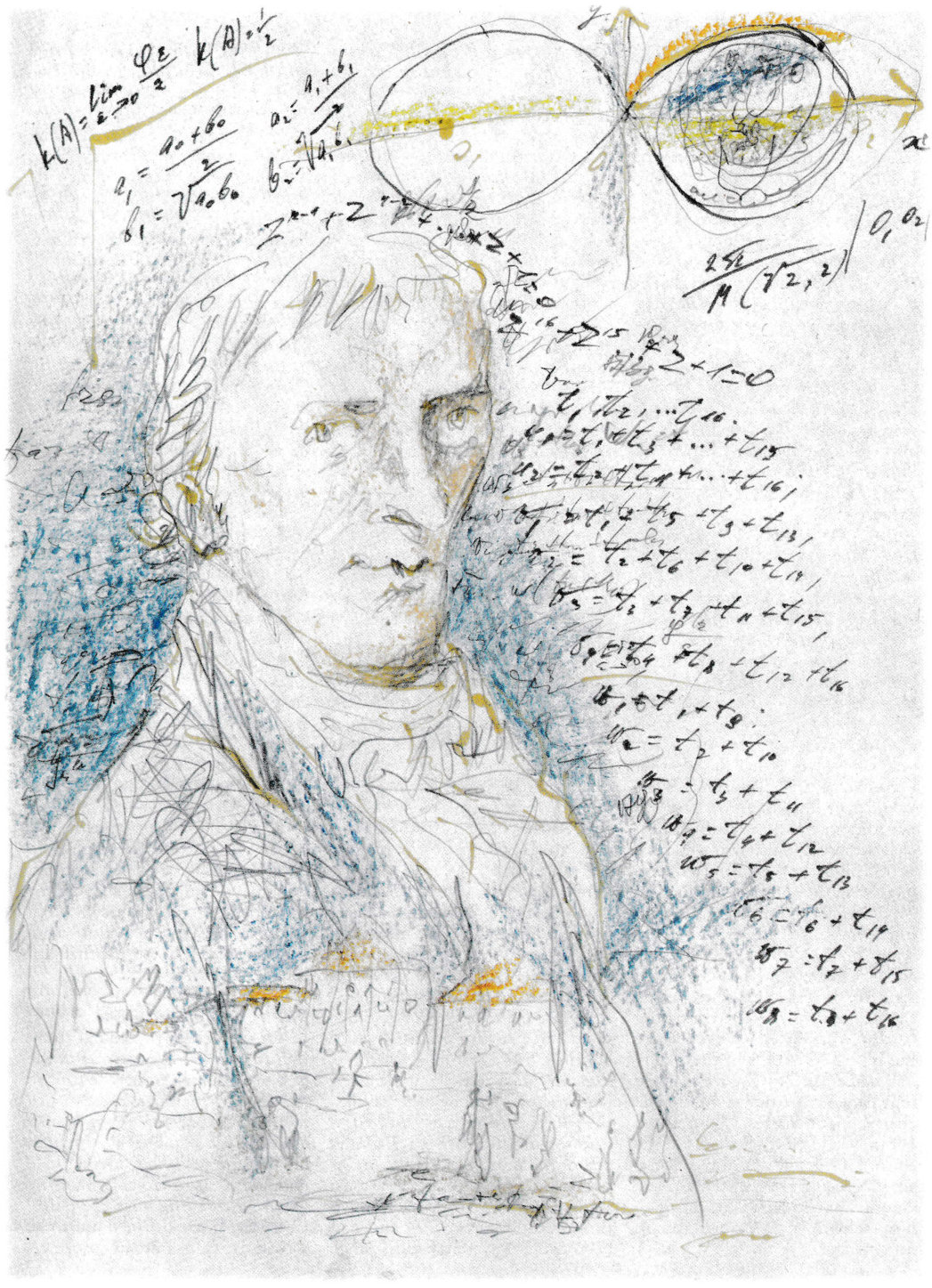
On the 1st of January 1801, the astronomer Piazzi, who was making up a catalog of stars, found an unknown star of the 8th magnitude. He observed it for 40 days and then addressed prominent astronomers, asking them to continue the observations. For various reasons, his request was not fulfilled. In June, this information reached Zach, who published the only astronomic journal at that time. Zach assumed that this was a planet that was suspected to exist between Mars and Jupiter. Zach’s hypothesis seemed very likely and the “lost” planet had to be found quickly. For this purpose, its orbit was to be computed. However, it was beyond the possibilities of astronomers to compute an elliptic orbit knowing only the 9-degree arc that had been observed by Piazzi. In September of 1801, Gauss abandoned all his affairs and got down to computations. He finished them in November, and the results were published in the December issue of Zach’s journal. At night from the 31st of December to the 1st of January—exactly a year after Piazzi’s observations—the renowned German astronomer Olbers found the planet on the basis of these calculations; the new planet was named Ceres. This discovery created quite a sensation.
Art by Vadim Ivanyuk
On the 25th of March 1802, Olbers discovered yet another planet, called Pallas. Gauss quickly computed its orbit, showing that it also was located between Mars and Jupiter. The effectiveness of Gauss’ computational methods became apparent.
Thus, Gauss gained recognition. One of the signs of this recognition was his election as a corresponding member of the St. Petersburg Academy of Sciences. Soon he was invited to take the post of Director of the St. Petersburg observatory. Gauss wrote that he felt flattered to be invited to the city where Euler had worked, and seriously considered accepting this offer. In his letters, Gauss wrote that the weather was often bad in St. Petersburg, so he would have time for his own studies in addition to making astronomical observations. He also wrote that the 1000 rubles he was offered were more than the 400 thalers which he got in Brunswick, but that the cost of living was higher in St. Petersburg.
At the same time, Olbers made efforts to keep Gauss in Germany. As early as in 1802, Olbers asked the curator of the University of Göttingen to invite Gauss to take the post of Director of the newly founded observatory. Olbers wrote that Gauss had an aversion to the chair of mathematics. Gauss agreed but moved to Göttingen only at the end of 1807. In the meantime, Gauss got married. In 1806, the Duke died. Gauss was sincerely attached to him, and now nothing held him in Brunswick.
Life in Göttingen was not easy for Gauss. In 1809, after the birth of a son, his wife died, and then the child died also. In addition, Napoleon levied a heavy tribute on Göttingen. Gauss himself had to pay an excessive tax of 2000 francs. Olbers and Laplace tried to pay this tax for Gauss, but he proudly refused. However, another anonymous benefactor paid the tax, and this time, there was no one to return the money to (later, it became known that this benefactor was the elector of Mainz, a friend of Goethe). Gauss wrote, between remarks on the theory of elliptic functions, that death was better than such a life. People didn’t appreciate his work and considered him an eccentric at best. Olbers tried to comfort Gauss, saying that one shouldn’t expect understanding but should pity people and serve them.
In 1809, the famous Theoria Motus Corporum Coelestium (Theory of Motion of Celestial Bodies Revolving around the Sun by Conic Sections) was published. This book was finished as early as in 1807. The delay in printing was partly due to the apprehension of the publisher that there would be no demand for the book in German, and Gauss refused to publish his book in French for patriotic considerations. The compromise settlement was to publish it in Latin. This was the only Gauss’ book on astronomy (besides this book, he also published several papers).
In this book, Gauss presented his method for calculating orbits. In order to demonstrate the effectiveness of his method, he repeated the calculation of the orbit of the comet of the year 1769, which had been calculated earlier by Euler. Euler spent three days of intensive work on this job and lost his eyesight as a result. Gauss carried out the job in only an hour. Among other things, the book presented the least-squares method, which remains one of the most widespread methods for the analysis of observations. Gauss claimed that he had known this method since 1794 and had been using it systematically since 1802. (The least-squares method was published by Legendre two years before the Theoria Motus Corporum Coelestium.)
In 1810, Gauss received many honors: he won the prize of the Paris Academy of Sciences and the gold medal of the Royal Society of London, and he was also elected to membership in several academies.
In 1804, the Paris Academy of Sciences chose as a topic for the great prize (a gold medal of 1 kg): the theory of perturbations of Pallas. The deadline was twice postponed (eventually to 1816) in order for Gauss to be able to present his work. Although Gauss’ student Nicolai (“a youth tireless in calculations”) helped him, the calculations still weren’t finished because of Gauss’ depressed state of mind.
Gauss continued his regular studies in astronomy almost until his death. The famous comet of 1812 (which “portended” the Moscow fire) was observed on the basis of Gauss’ calculations. On the 28th of August, Gauss observed an eclipse. Gauss had many student astronomers (Schumacher, Herling, Nicolai, and Struve). The prominent German geometers Möbius and Staudt studied astronomy rather than geometry under Gauss. Gauss also corresponded with many astronomers, read papers and books on astronomy, and wrote reviews. We know a lot about his studies in mathematics from his letters to astronomers. The image of Gauss the astronomer was quite different from that of an inaccessible hermit, a notion that existed among mathematicians at that time.
Geodesy (Earth measurement)
In 1820, Gauss turned his attention to geodesy. As early as in the beginning of the century, he tried to use the measurements of an arc of a meridian carried out by French geodesists to set a standard for length measurements (the meter). He planned to use it to calculate the Earth’s flattening near the poles. However, the arc turned out to be too short. Gauss dreamed of performing measurements of a sufficiently long arc of a meridian, but was able to get down to this work only in 1820. Although the measurements took as long as two decades, Gauss was unable to fully implement his idea. Investigations concerning the analysis of observations obtained in connection with geodesy were of major importance (his main publications on the least-squares method date to this time). Various geometric results were obtained in connection with the necessity of performing measurements on the surface of an ellipsoid.
In the 1820s a move to Berlin was discussed, where Gauss was to head an Institute. The most prominent young mathematicians were to be invited there, including Jacobi and Abel. The negotiations dragged on for four years—there were disagreements over whether Gauss was to give lectures and how much he was to be paid (1200 or 2000 thalers a year). Negotiations were unsuccessful. However, all was not lost—Gauss’ salary in Göttingen was raised to what he was supposed to receive in Berlin.
Intrinsic geometry of surfaces
Geodesy was responsible for the fact that mathematics again became Gauss’ main occupation for a short period of time. In 1816, he considered a generalization of the main problem of cartography—mapping one surface onto another so that the image was similar to the original in the smallest details. Gauss advised Schumacher to choose this question when announcing a competition for the prize of the Copenhagen scientific society. The competition was announced in 1822. The same year, Gauss presented a memoir in which he introduced characteristics that permitted a complete solution to the problem, particular cases of which had been analyzed by Euler and Lagrange (the mapping of a sphere or a surface of revolution onto a plane). Gauss gave a detailed description of the conclusions from his theory for numerous particular cases, some of which arose in geodesy.
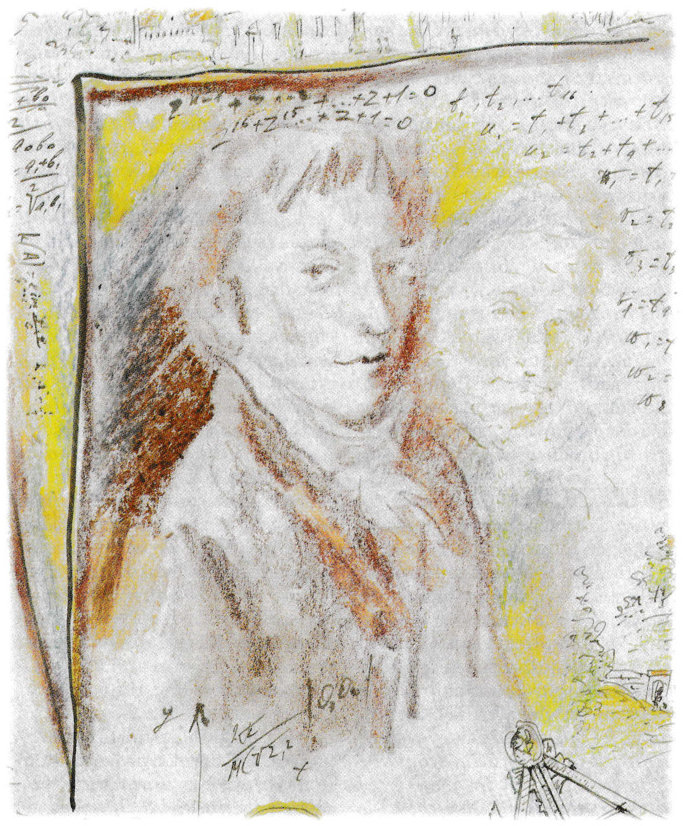
In 1828, Gauss published his basic memoir on geometry called General Investigations on Curved Surfaces. It was devoted to the intrinsic geometry of a surface, that is to everything that is related to the surface itself rather than to its position in space.
Broadly speaking, the intrinsic geometry of a surface describes its properties that can be found when one “remains on the surface itself.” One can measure distances on surfaces by stretching a thread so that it remains entirely on the surface. Such curves are called geodesic arcs (they are analogs of straight lines on a plane). One can analyze angles between geodesics and study the properties of geodesic triangles and polygons. If we warp a surface (thinking of it as a film which can neither be stretched nor torn), the distances between its points will remain unchanged: geodesics will remain geodesics, and so on.
It turns out that one can find out whether a surface is curved or not without leaving it. A “truly curved” surface cannot be developed onto a plane. Gauss introduced a numerical measure of the curvature of a surface.
Consider a neighborhood of a point $A$ with an area of $\varepsilon$ . Consider a normal (perpendicular) to the surface, of unit length, at each point of this neighborhood. For a plane, all the normals are parallel, while for a curved surface they diverge. Translate all these normals so that they start from the same point. Then, the endpoints fill a domain on the unit sphere. Let $\varphi(\varepsilon)$ be the (oriented) area of this domain. Then
\[\lim_{\varepsilon \to 0} \frac{\varphi(\varepsilon)}{\varepsilon}\]is a measure of curvature of the surface at point $A$ . It turns out that $k(A)$ remains the same under any warping of the surface. A part of a surface can be developed onto a plane if and only if $k(A) = 0$ for all its points. The measure of curvature is related to the sum of the angles of a geodesic triangle.
Gauss studied surfaces of constant curvature. The sphere is a surface of a constant positive curvature (for all its points, $k(A) = 1/R$ , where $R$ is the radius). In his draft notes, Gauss mentioned a surface of a constant negative curvature. Later, such a surface was called pseudosphere, and Beltrami proved that its intrinsic geometry was exactly the geometry of Lobachevsky.
Non-Euclidean geometry
There is evidence that Gauss was interested in the parallel postulate as early as in 1792. In Göttingen, he often discussed this problem with Farkas Bolyai, a student from Hungary. We know from Gauss’ letter of 1799 to Bolyai that he clearly realized that there were numerous propositions which implied the fifth postulate of Euclid. Gauss wrote: “I achieved much of what would be taken for a proof by the majority of people.” And then: “However, the road I have chosen leads to doubt about the truth of geometry rather than to the desired destination.” There was only one step from this point to the realization of the possibility of constructing a non-Euclidean geometry. However, this step was not taken, although this phrase is often taken as evidence that Gauss had come to non-Euclidean geometry as early as 1799.
The following words of Gauss must be taken into account. He wrote that he could not devote enough time to this problem. It should be noted that the problem of parallels was not mentioned in his diary; evidently, it was never the focus of Gauss’ interests. In 1804, Gauss refuted the attempts of Bolyai to prove the parallel postulate. His letter ended in the following words: “However, I still hope that sometime, even before my death, these obstacles will be overcome.” These words give evidence that Gauss hoped that a proof would be found.
Here is some more evidence. “In the theory of parallels we haven’t yet left Euclid behind. This is a disgraceful part of mathematics that must take quite a different form sooner or later” (1813). “We haven’t gotten beyond the point reached by Euclid 2000 years ago” (1816). However, in the same year of 1816, Gauss wrote about “a gap which cannot be filled,” and in 1817, he wrote in a letter to Olbers: “My conviction that the ‘necessity’ of our geometry cannot be proved, at least by the human mind and for the human mind, becomes increasingly strong. It may happen that in another life we would arrive at a different view on the nature of space, but now this view is beyond our understanding. Until that time, geometry must be ranked with mechanics rather than with arithmetic, which is purely an a priori science.”
About the same time, similar thoughts about the impossibility of proving the fifth postulate were expressed by Schweikart, a lawyer from Königsberg. He assumed that an “astral geometry” existed along with the Euclidean geometry, in which the fifth postulate didn’t hold. Herling, a student of Gauss who worked in Königsberg, wrote to Gauss about Schweikart and sent his note. In his reply, Gauss said: “Almost everything is copied from my heart.” The work of Schweikart was continued by his nephew, Taurinus, with whom Gauss exchanged several letters beginning in 1824.
In his letters, Gauss stressed that his opinions were private and must not be made public in any case. He didn’t believe that his ideas could be understood and was afraid of attracting the attention of a crowd of laymen. Gauss experienced tough years and he highly appreciated the opportunity of working calmly. He warned Herling, who was only going to mention that the parallel postulate may be wrong: “Wasps whose nest you are going to destroy will rise around your head.” Gradually, Gauss arrived at the conclusion that he must write down his results, but not publish them. He wrote: “It seems that it will take a long time to prepare my extensive investigations of this question for publication. It is quite likely that I won’t resolve upon publishing them at all, because I am afraid of the shouts of Boeotians1 which they will raise if I make all my opinions public” (a letter to Bessel, 1829). In May, 1831, Gauss began a systematic description of his studies: “It has been several weeks that I have been committing to paper the results of my work on this subject. This work was partly done 40 years ago, but it has never been put on paper; thus, I had to reconstruct the entire reasoning three or four times. However, I wouldn’t like it if my work died with me.” (A letter to Schumacher)
However, in 1832, Gauss received from Farkas Bolyai a small paper by his son Janos called “Appendix” (this title was explained by the fact that the paper was published as an appendix to a large book by his father). “My son appreciates your opinion more than the opinion of the whole of Europe.” The contents of the paper amazed Gauss: it presented in a complete and systematic form the construction of a non-Euclidean geometry. This paper was quite different from fragmented remarks and conjectures of Schweikart and Taurinus. Gauss himself was going to give such an outline of the theory in the near future. He wrote to Herling: “I found all my ideas and results presented very elegantly, though they are exposed in a very condensed form, which makes them difficult to understand for those who don’t work in this field… I think that this young geometer Bolyai is a genius.” Here is what he wrote to the father: “…the entire contents of this work, the way your son went about it and the results he obtained are almost the same as my own, which I partially obtained 30 or 35 years ago. I am really very surprised. I have committed to paper some of my results but did not intend to publish them during my lifetime; I just didn’t want these results to perish after my death. For this reason I am staggered by what has happened—it frees me from this work. I am also very glad that it was the son of my old friend who anticipated my work.” However, Janos Bolyai didn’t receive any public support from Gauss. It seems that simultaneously Gauss stopped his regular notes on non-Euclidean geometry, although fragmented notes of the middle 1840s do exist.
In 1841, Gauss got to know the German edition of Lobachevsky’s work (his first publications date to 1829). As usual, Gauss was interested in other works of this author, but expressed his opinion only in correspondence with close friends. However, in 1842, Gauss recommended that Lobachevsky be elected a correspondent member of the Royal Scientific Society of Göttingen as “one of the best mathematicians of the Russian state.” Gauss himself informed Lobachevsky of his election, but neither in the recommendation, nor in the diploma that was given to Lobachevsky, was there a mention of non-Euclidean geometry.
Gauss’ works on non-Euclidean geometry became known only when his archive was published after his death. Thus, by refusing to publish his great discovery, Gauss provided himself with an opportunity to work calmly. This fact raised an unremitting discussion about whether such a position is acceptable or not.
It must be noted that Gauss was interested not only in the purely logical question of the possibility of proving the fifth postulate. He also tried to establish the place of geometry in the natural sciences and the question of the true geometry of the physical world (see his opinion of 1817 above). He discussed an opportunity for an astronomic verification and was interested in Lobachevsky’s ideas concerning this issue. In his geodetic work, Gauss couldn’t resist the temptation of measuring the sum of the angles of the triangle formed by the summits of three mountains: Hohenhagen, Brocken, and Inselberg. The deviation from $2\pi$ didn’t exceed 0.2’.
Electrodynamics and geomagnetism
By the end of the 1820s, Gauss, who was already over 50, began to seek new fields for his research. This is evidenced by two articles of 1829 and 1830. The first of them was devoted to general principles of mechanics (Gauss’ principle of least constraint); the other was concerned with capillary phenomena. Gauss had decided to study physics, but his particular interests had not been decided yet. In 1831, he tried to do research in crystallography. This was a very difficult year for Gauss: his second wife died, and he developed bad insomnia. The same year, Wilhelm Weber, the 27-year old physicist who had been invited at Gauss’ initiative, came to Göttingen. Gauss made his acquaintance in 1828 at Humboldt’s home. Although Gauss, then 54, was a very reserved man, he nevertheless found in Weber a companion such as he had never before met for doing research.
Klein wrote that “the internal difference of these two people manifested itself even in their appearance. Gauss was a thickset man, a true representative of Lower Saxony, taciturn and reserved. Small, graceful, and lively Weber was his antithesis. He was very talkative and amiable, which betrayed a native Saxon. Indeed, he came from Wittenberg, this country of ‘quintessential Saxons.’ The Göttingen monument to Gauss and Weber makes this difference less noticeable; even in height they seem closer than in real life.”
Gauss and Weber were interested in electrodynamics and geomagnetism. Their activity wasn’t purely theoretical; it also brought some practical results. In 1833, they invented electromagnetic telegraphy (this event is memorialized in the monument). The first telegraph connected the observatory and the physics institute. However, they couldn’t introduce the device for large-scale use because of financial reasons.
While studying magnetism, Gauss arrived at the conclusion that systems of physical units must be constructed on the basis of several independent units, and all other units must be expressed in terms of the basic ones.
The study of terrestrial magnetism was based both on observations made at the magnetic observatory in Göttingen and on data collected in various countries by the Union for Observing Terrestrial Magnetism, which was founded by Humboldt after his return from South America. At the same time, Gauss created one of the most important divisions of mathematical physics—potential theory.
The common work of Gauss and Weber was interrupted in 1843, when Weber was expelled from Göttingen with six other professors for signing a letter to the King, which pointed to violations of the constitution by the King (Gauss didn’t sign this letter). Weber returned to Göttingen only in 1849, when Gauss was already 72.
***
We conclude our story with the following words of Klein: “Gauss reminds me of the highest summit of the Bavarian ridge as it stands before the eyes of an observer looking from the North. In this mountain range, isolated summits become higher and higher from East to West, reaching the maximum height in a mighty central giant. Breaking steeply, it is replaced by a lowland of a new form with spurs spreading deeply into it, and streams that flow down from this giant bring moisture and life.”
-
Traditionally in ancient Greece, the citizen of Boeotia were known for their weak intellectual ability. ↩