Source: The Mathematical Gazette, November 2025, pp. 539-542
109.43 “Look-see” proofs that $\pi > e$
Introduction
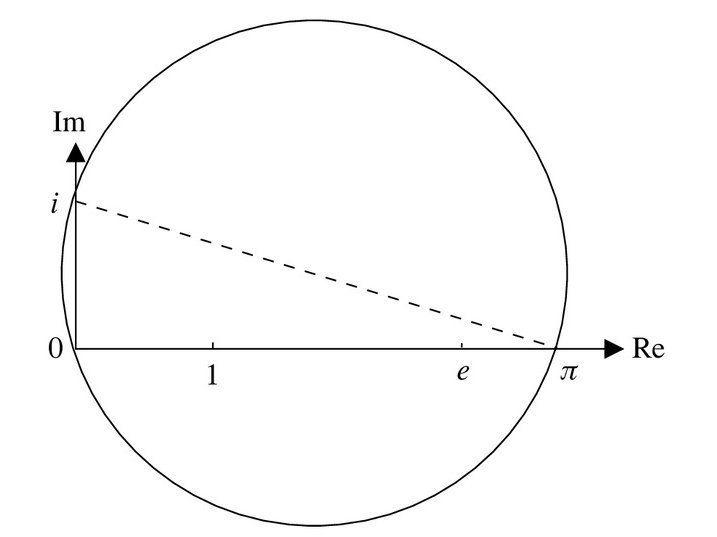
We can surely all agree on the significance and beauty of Euler’s equation $e^{i\pi} + 1 = 0$ , which was once memorably described by Michael Atiyah in [1] as, “the mathematical equivalent of Hamlet’s phrase ‘To be, or not to be’ — very short, very succinct, but at the same time very deep.” But I am also constantly intrigued by the proximity of the key players $0, 1, e, \pi, i$ in the Argand diagram, Figure 1, where the smallest circle that contains all of them has radius $\frac{1}{2}\sqrt{\pi^2 + 1}$ (which is surprisingly close to $\sqrt{e}$ ).
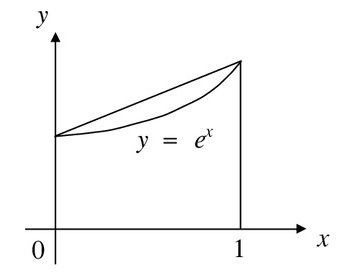
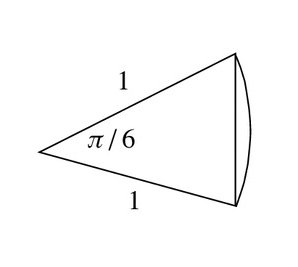
Particularly intriguing is the closeness of those two stalwarts of analysis $e$ and $\pi$ and, for many years, I have been on a perhaps rather idiosyncratic quest to find a “look-see” proof that $\pi > e$ , where an expression involving $\pi$ and $e$ makes it immediately clear without any calculation that $\pi > e$ . Thus I am ruling out even light-touch calculations that separately establish (say) $e < 3$ and $3 < \pi$ such as those in Figure 2, where comparison of areas gives $\frac{1}{2}(e + 1) > e - 1$ in (a) (from the trapezium and the area under the graph) and $\frac{1}{2} \sin \frac{\pi}{6} < \frac{1}{2} \cdot \frac{\pi}{6}$ (from the triangle and sector).
(a)
(b)
At long last, I have found the proof I have been looking for: I warmly invite readers to find others!
Consider the integral $\int_{0}^{\pi/2} \ln \left( \frac{x}{\sin x} \right) dx$ .
It is manifestly positive because $x > \sin x$ for $0 < x < \frac{1}{2}\pi$ . (A proof of this in the spirit of this Note would be $x - \sin x = \int_{0}^{x} 1 - \cos t \, dt = 2 \int_{0}^{x} \sin^2 \frac{1}{2}t \, dt < 0$ .)
Thus
\[0 < \int_{0}^{\frac{1}{2}\pi} (\ln x - \ln \sin x) \, dx = \left[ x \ln x - x \right]_{0}^{\frac{1}{2}\pi} - \color{#4bbaff} \int_{0}^{\frac{1}{2}\pi} \ln \sin x \, dx\] \[= \frac{\pi}{2} \ln \frac{\pi}{2} - \frac{\pi}{2} + \frac{\pi}{2} \ln 2,\]using the integral $\int_{0}^{\frac{1}{2}\pi} \ln \sin x \, dx = -\frac{\pi}{2} \ln 2$ (see below), so that
\[0 < \int_{0}^{\frac{1}{2}\pi} \ln \left( \frac{x}{\sin x} \right) dx = \frac{\pi}{2} (\ln \pi - 1) = \frac{\pi}{2} \ln \left( \frac{\pi}{e} \right), \quad (1)\]from which $\pi > e$ follows.
(To evaluate $I = \int_{0}^{\frac{1}{2}\pi} \ln \sin x \, dx$ , compare the ends of the following calculation:
\[I = \int_{0}^{\frac{1}{2}\pi} \ln \sin x \, dx = \frac{1}{2} \int_{0}^{\pi} \ln \sin x \, dx = \int_{0}^{\pi/2} \ln \sin 2t \, dt\] \[= \int_{0}^{\pi} (\ln 2 + \ln \sin t + \ln \sin \left( \frac{1}{2}\pi - t \right)) dt = \frac{\pi}{2} \ln 2 + I + I.)\]The rest of this Note describes my circuitous quest to reach this satisfying endpoint.
The quest
A casual glance through the pages of tables of integrals such as [2] reveals several definite integrals with values that are expressions involving both $\pi$ and $e$ . Typical examples are $\int_{0}^{\infty} \frac{2 \cos x}{1 + x^2} dx = \frac{\pi}{e}$ and $\int_{0}^{\infty} e^{-\frac{1}{4}(x^2 + \frac{1}{x^2})} dx = \sqrt{\frac{\pi}{e}}$ . But quickly establishing that the integrals are greater than 1 defeated me.
So my quest sharpened into a search for other definite integrals with values involving $\frac{\pi}{e}$ . My “eureka moment” came when I serendipitously stumbled across Problem 82.2 in the excellent Problem section curated by Ian Short in the ever-interesting open-access Irish Mathematical Society Bulletin, [3]. This challenged readers to show that $\int_0^\infty \frac{\sinh x - x}{x^2 \sinh x} dx = \ln 2$ , with a rider to show further that $\int_0^\infty \frac{\sinh x - x}{x^2 \sinh x} e^{-x} dx = \ln \pi - 1 = \ln \left( \frac{\pi}{e} \right)$ . A solution by contour integration to the initial problem was duly published, but a solution to the rider was not. And it was the rider that piqued my interest, for it implies that $\ln \left( \frac{\pi}{e} \right) > 0$ since the integrand is positive because $\sinh x - x > 0$ . (Quick proof: $e^x - 2x - e^{-x} = \int_0^x (e^{t/2} - e^{-t/2})^2 dt > 0$ , for $x > 0$ .)
So my quest distilled into trying to show that $\int_0^\infty \frac{\sinh x - x}{x^2 \sinh x} e^{-x} dx = \ln \left( \frac{\pi}{e} \right)$ : as it happens, the proof below can be modified to give an alternative proof that $\int_0^\infty \frac{\sinh x - x}{x^2 \sinh x} dx = \ln 2$ as well.
The Maclaurin expansion for $\sinh x$ gives $\frac{\sinh x - x}{x^2} = \sum_{n=1}^\infty \frac{x^{2n-1}}{(2n+1)!}$ , so that
\[\int_0^\infty \frac{\sinh x - x}{x^2} \cdot \frac{e^{-x}}{\sinh x} = \sum_{n=1}^\infty \frac{1}{(2n+1)!} \int_0^\infty x^{2n-1} \cdot \frac{2e^{-2x}}{1 - e^{-2x}} dx\] \[= \sum_{n=1}^\infty \sum_{k=0}^\infty \frac{2}{(2n+1)!} \int_0^\infty x^{2n-1} e^{-(2k+2)x} dx,\]on expanding $(1 - e^{-2x})^{-1}$ binomially.
But, substituting $t = (2k+2)x$ , we obtain
\[\int_0^\infty x^{2n-1} e^{-(2k+2)x} dx = \frac{1}{(2k+2)^{2n}} \int_0^\infty t^{2n-1} e^{-t} dt = \frac{(2n-1)!}{(2k+1)^{2n}},\]so that
\[\int_0^\infty \frac{\sinh x - x}{x^2 \sinh x} e^{-x} dx = 2 \sum_{n=1}^\infty \sum_{k=0}^\infty \frac{1}{2n(2n+1)} \cdot \frac{1}{(2k+2)^{2n}} = 2 \sum_{n=1}^\infty \frac{4^{-n} \zeta(2n)}{2n(2n+1)}, \quad (2)\]where, as usual, $\zeta(2n) = \sum_{k=0}^\infty \frac{1}{(k+1)^{2n}}$ .
We next invoke from [4] (for example), Euler’s generating function for $\zeta(2n)$ , $2 \sum_{n=1}^\infty \zeta(2n) t^{2n} = 1 - \pi t \cot \pi t$ .
From this, $2 \sum_{n=1}^\infty \zeta(2n) t^{2n-1} = \frac{1}{t} - \pi t \cot \pi t$ so, integrating from 0 to $x$ and carefully inserting limits, $2 \sum_{n=1}^\infty \frac{\zeta(2n)}{2n} x^{2n} = \ln \left( \frac{\pi x}{\sin \pi x} \right)$ .
Integrating again from $0$ to $\frac{1}{2}$ then gives
\[\sum_{n=1}^{\infty} \frac{\zeta(2n) 4^{-n}}{2n(2n + 1)} = \int_0^{\frac{1}{2}} \ln \left( \frac{\pi x}{\sin \pi x} \right) dx\] \[= \frac{1}{\pi} \int_0^{\frac{\pi}{2}} \ln \left( \frac{u}{\sin u} \right) dx, \text{ on setting } u = \pi x\] \[= \frac{1}{\pi} \cdot \frac{\pi}{2} \ln \left( \frac{\pi}{e} \right), \text{ by (1)}\] \[= \frac{1}{2} \ln \left( \frac{\pi}{e} \right). \quad (3)\]Tracking back to (2), we finally see that $\int_0^{\infty} \frac{\sinh x - x}{x^2 \sinh x} e^{-x} dx = \ln \left( \frac{\pi}{e} \right)$ .
Establishing this, proved the catalyst for finding the simpler integral, (1), which emerged from the concluding steps of the proof. Even better, (3) provides another (and perhaps the ultimate) “look-see” proof that $\pi > e$ , which does not rely on any auxiliary results such as $x > \sin x$ or $\sinh x - x > 0$ : $\ln \left( \frac{\pi}{e} \right) = 2 \sum_{n=1}^{\infty} \frac{\zeta(2n) \cdot 4^{-n}}{2n(n + 1)}$ . A series of positive terms!
Acknowledgement
I am grateful to the referee for carefully reading the first draft of this note and highlighting several areas for improvement.
References
-
Michael Atiyah’s imaginative state of mind, Quanta magazine: available on-line at
https://www.quantamagazine.org/michael-atiyahs-mathematical-dreams-20160303/ -
I. S. Gradshteyn and I. M. Ryzhik, Tables of integrals, series and products, Academic Press (1980).
-
Problem 82.2, Irish Math. Soc. Bulletin 82 (Winter 2018), p. 105 : available on-line at https://www.irishmathsoc.org/bulletin/
-
G. J. O. Jameson, Series involving $\zeta(n)$ , Math. Gaz. 98 (March 2014), p. 64.
NICK LORD